Android and iOS Obfuscation Done Right:
Protecting the Final Container
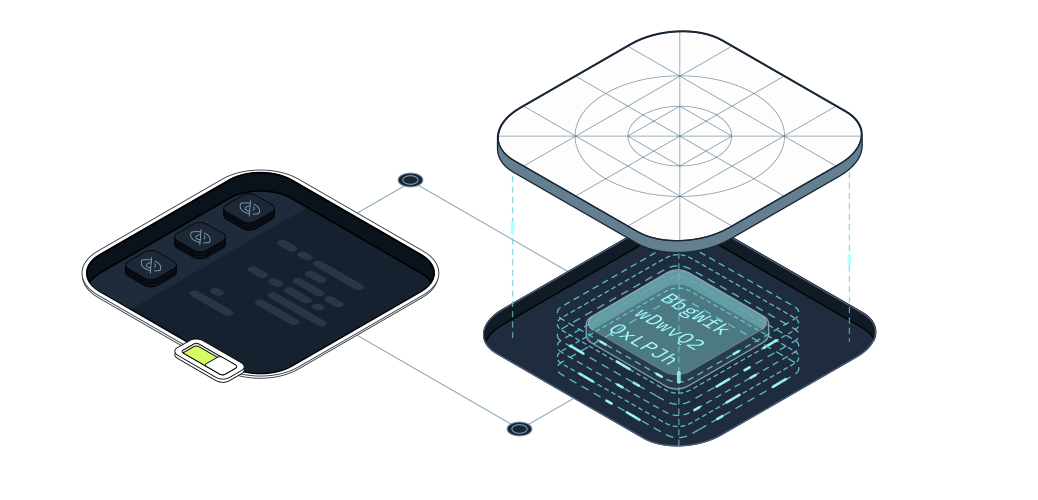
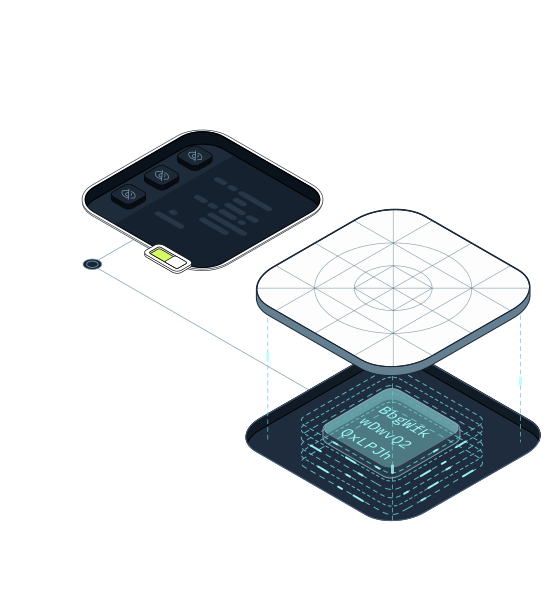
There’s a simple test that separates a real Android or iOS obfuscator from a source-level tool with good marketing: ask what artifact it actually protects.
If the answer is “your source code” or “your Gradle module,” then you have a partial solution. The artifact your users download – and the artifact attackers reverse engineer – is the final container: the APK or AAB on Android, the IPA or XCArchive on iOS. If your protection never sees that container, then it cannot guarantee its integrity.
This is the principle DexProtector has been built around for fifteen years: you cannot protect the integrity of what you don't see. That’s why you must work with the final container.

Why post-build obfuscation matters
Most obfuscation tools operate at the source or intermediate-representation level. They rename classes, perhaps encrypt some strings, and then hand the result back to your build pipeline where signing, packaging, resource processing, and third-party tooling continue to modify the artifact. Whatever integrity guarantees existed at the moment of obfuscation are gone by the time the app ships.
A post-build Android obfuscator and iOS obfuscator works differently. DexProtector, for example, takes your finished, ready-to-ship container, be it APK, AAB, IPA, or XCArchive, and applies the following protection layers directly to it:
Code hardening
Obfuscation, encryption, and virtualization of Dalvik bytecode, native libraries, and iOS binaries, applied to the exact code that will run on devices.
Resource and asset encryption
Strings, assets, and resources are encrypted in the final package, not in an intermediate form that later tooling can disturb.
Integrity control
Dynamic cryptographic key calculations at runtime are derived from the protected container itself. Modify the container – repackage it, patch it, resign it – and the app stops working. This is only possible when protection is applied to the final artifact.
Runtime defense
During protection, DexProtector embeds its DexProtector Runtime Engine (DRE) into the app, providing RASP that detects hooking frameworks, debuggers, emulators, and tampering at runtime.
AAB protection: the container Google actually distributes
Since Google Play made the Android App Bundle mandatory, “AAB protect” has become its own discipline. An AAB is not an APK:
Play generates device-specific APKs from it, which means naive protection approaches break: integrity checks computed against the bundle don’t match the split APKs that users receive.
A proper AAB protector has to understand the bundle format natively: protect base and feature modules, survive Play's split generation, and still deliver integrity verification on the device-specific APKs that end up on handsets. DexProtector supports AAB as a first-class input precisely because this is where real-world Android distribution happens. The same applies to APKs for sideloaded, enterprise, and alternative-store distribution.
IPA and XCArchive obfuscation on iOS
iOS is often assumed to be “safe enough” out of the box, but the teams attacking mobile banking apps disagree. Decrypted IPAs circulate within hours of release, and Frida and similar dynamic instrumentation frameworks work just as well on iOS as they do on Android.
An iOS obfuscator like DexProtector that operates on the final container – the IPA or the XCArchive you produce in Xcode – can apply protections that source-level Swift/Objective-C obfuscation cannot:
- Obfuscation and encryption of the actual Mach-O binaries that ship, including frameworks and extensions inside the archive.
- Integrity control bound to the final, signed artifact.
- RASP via the embedded DRE: jailbreak detection, anti-instrumentation, anti-debugging, and environment checks at runtime.
- Secure network communications: SSL pinning and certificate transparency enforcement – hardened, into the shipped binary.
Working with the XCArchive means protection drops into your existing release pipeline: archive in Xcode or CI as usual, protect, then export and submit. No source changes, no SDK to integrate, no build-system surgery.
On-premises by design: your build never leaves your environment
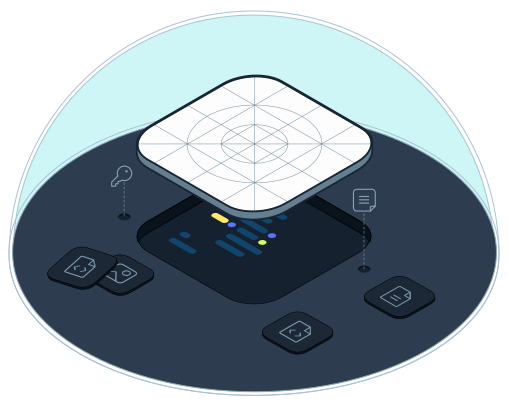
There is a quiet irony in some app protection products: to protect your most sensitive artifact, they ask you to upload it to someone else's cloud.
DexProtector takes the opposite position. The entire obfuscation and protection process for Android and iOS runs fully on-premises, inside your own environment, with no reliance on any cloud service or remote process. Your unprotected APK, AAB, IPA, or XCArchive never crosses your network boundary. No third party ever holds your pre-release binary, your signing-adjacent artifacts, or knowledge of your release schedule.
This matters for reasons beyond comfort alone:
Confidentiality of the unprotected artifact. The build you protect is the most sensitive version of your app that will ever exist. Sending it to an external service creates exactly the exposure you bought protection to prevent.
Compliance and data residency. Banks, payment providers, and public-sector bodies often simply cannot ship pre-release binaries to external processors. On-premises protection makes the conversation with your security and compliance teams short.
Availability and pipeline independence. Your release process never blocks on a vendor’s cloud uptime, queue, or maintenance window. Protection runs deterministically in your CI/CD, air-gapped if you need it to be.
No silent dependency. A protection step that calls home is itself an attack surface and a single point of failure. A self-contained, local process is neither.
Stability and speed are security features
An obfuscator that crashes one in ten thousand sessions doesn’t get deployed, or gets quietly dialed down to its weakest settings. DexProtector is engineered to run fast and remain stable because its users are banks, payment wallets, SoftPOS providers, retailers, and public-sector apps serving citizens at national scale. Today there are 12 billion+ protected app installation instances running DexProtector protection worldwide. At that scale, instability is not an option, and performance overhead is measured obsessively.
Independently evaluated, year after year
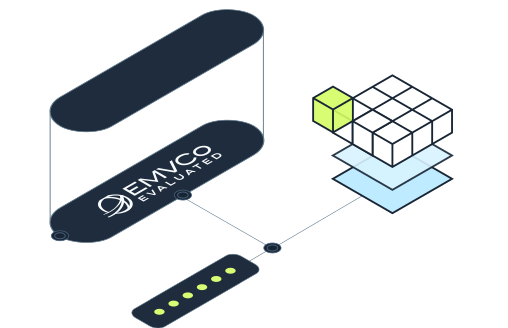
Claims about obfuscation strength are cheap. Evaluations aren’t.
DexProtector has been evaluated and approved by independent security laboratories for six consecutive years under EMVCo’s software-based mobile payment security program – where robust code protection is one of the core security requirements – the standard that payment schemes rely on for SoftPOS and mobile payment acceptance. Some of our clients have trusted DexProtector for thirteen years, through every major Android and iOS platform shift.
Beyond obfuscation: visibility and isolation
Obfuscation and RASP are the foundation. Fifteen years of defending the same apps against evolving attackers leads naturally to two further layers:
Alice Threat Intelligence
real-time telemetry from your protected apps. Because the DRE is already embedded during protection, enabling telemetry is straightforward: you see hooking attempts, tampered environments, and emerging attack patterns across your install base as they happen. Alice RDA, our upcoming real-time device attestation service, extends this into continuous device trust decisions.
Licel vTEE
a virtual trusted execution environment extends the hardware root of trust through the parts of a workflow that hardware alone doesn’t cover; for operations (PIN handling, key management, payment flows) that need more than hardening.
How to evaluate an Android or iOS obfuscator
If you’re comparing tools, these questions can help you to cut through the noise:
Does it protect the final container – APK, AAB, IPA, and XCArchive? Or only source/intermediate code?
Does the protection process run entirely on-premises, in your environment, with no cloud upload of your unprotected binary?
Is integrity verification bound to the shipped artifact, so repackaging kills the app?
Does it include runtime protection (RASP), or is obfuscation the only layer?
Has it been independently evaluated, recently and repeatedly, by accredited security labs?
Who runs it in production, at what scale, and for how long?
FAQs
What’s the best way to obfuscate an APK or AAB?
Apply protection to the final container after the build completes. Post-build protection lets obfuscation, encryption, and integrity control cover the exact artifact distributed to users, including Play-generated splits from an AAB.
Can you obfuscate an iOS app without source code changes?
Yes. DexProtector protects the IPA or XCArchive directly, so obfuscation, encryption, RASP, and SSL pinning enforcement are applied without modifying source code or integrating an SDK.
Does obfuscation slow the app down?
Protection layers add overhead, which is why engineering for speed matters. DexProtector’s protection, including its native runtime engine, is designed for negligible startup and runtime impact even in high-frequency payment flows.
Is ProGuard or R8 enough?
R8 shrinks and renames code for size, not security; names are trivially recoverable and there is no encryption, integrity control, or runtime defense. It's a build tool, not an Android obfuscator in the security sense.
Do I have to upload my app to a cloud service to protect it?
Not with DexProtector. Protection for both Android and iOS runs fully on-premises in your own environment – including air-gapped CI/CD – so your unprotected binary never leaves your control.