Mobile Channel Protection
Securing the entire interaction between user, device, application, and backend.
In short:
Mobile app protection secures the code inside the app. Mobile channel protection secures the entire interaction; the application, the device, the runtime environment, and the communication with backend systems.
As mobile fraud increasingly begins on the device rather than the backend, securing the code alone isn't enough anymore. This page sets out what mobile channel protection means, why it has become necessary, and how the layers fit together here at Licel.
Mobile fraud often begins on the device rather than the backend. And the protections most organizations rely on were designed for a different era, when securing the application's code was enough to secure the interaction.
In the modern world of AI-assisted attack techniques, increasing regulatory pressures, and the vast scale of mobile commerce that each of us relies on, there’s simply too much at stake to think of mobile security through this narrow lens.
Mobile Channel Protection is the practice of securing every layer of the interaction between a user, their device, a mobile application, and the backend system it communicates with. It ensures the integrity, confidentiality, and authenticity of mobile interactions across the application itself, its runtime environment, and its communication flows with backend systems.
Whenever one of those layers is left unprotected, the consequences extend well beyond direct financial loss. This page sets out what mobile channel protection means, why it has become necessary, and how the layers fit together.
The Evolution of Mobile Threats
How do mobile applications get attacked?
And how has this changed over the last 15 years?
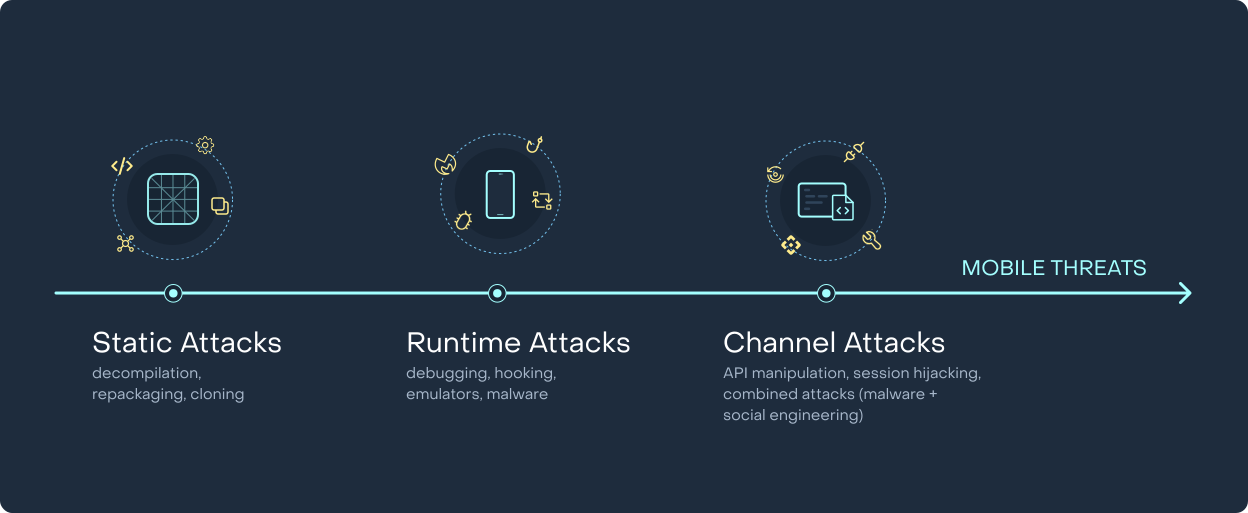
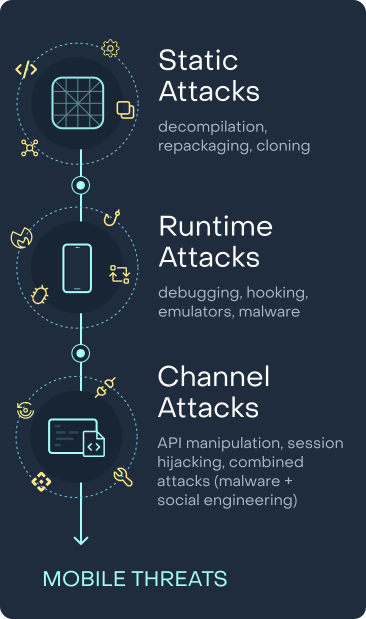
Mobile threats have evolved, with the attack surface expanding dramatically from a focus on the application itself, to the runtime environment, to the entire communication channel between the app and the backend. Put another way, there’s been a shift from static attacks, to runtime attacks, and to mobile channel attacks.
When apps started gaining traction and began to have an increasing influence over end users’ lives, attackers focused their efforts on the application binary itself. By decompiling, repackaging, and cloning apps, they could extract logic, steal credentials, and redistribute modified versions. Their target was primarily the code itself.
But static protections like encryption and obfuscation improved, making it tougher for bad actors to succeed with static attacks. So, their attacks became more dynamic. They switched to targeting apps while they were running. Dynamic instrumentation tools, debuggers, hooking tools, emulators, and malware allowed them to manipulate application behavior in real time; bypassing controls that looked solid on paper. Their target had changed from the application’s code to the execution itself.
Today, the most sophisticated attacks target the entire interaction between the mobile application and the backend. Mobile API manipulation, session hijacking, and combined attacks that blend malware with social engineering mean that even a well-protected app can still be part of a compromised mobile channel.
Modern attacks are more sophisticated and blurred than ever before. We’re living in a world where what was supposed to be a secure runtime environment on the device becomes a heavily compromised "stitched" environment where a part of the code is run on the device and a virtual camera injection attack is conducted in parallel with the assistance of a more powerful machine. This generates a completely convincing yet bogus video that can be injected back into the mobile environment to bypass eKYC checks.
In many ways the target today has become trust itself.
Security has evolved from protecting code, to protecting execution, to protecting the entire mobile channel.
Understanding this evolution is what makes the distinction between mobile app protection and mobile channel protection meaningful and necessary.
How is Mobile Channel Protection Different from Mobile App Protection?
Traditional mobile application security focuses on securing the code inside the app; reverse engineering protection, and preventing tampering and repackaging. This is essential, and, as you’ll see in the next section, it must remain as one of the key foundation stones of any serious mobile channel security strategy. But it’s also important to understand that it only addresses part of the problem. It should be seen as one of several layers.
Protecting code is not the same as protecting the interactions or operations that people carry out on mobile devices each day. A mobile app doesn't operate in isolation but rather it communicates constantly with backend systems, it processes sensitive data at runtime, and it operates in environments that neither the developer nor the organization controls. Mobile channel protection extends security across all of these dimensions rather than just the application binary.
Imagine for a second the idea of traditional app protection being like securing everything inside a coffee cup. From within that cup you can see and control what's in there, but you have no visibility into what's happening outside and around the cup. Mobile channel protection means stepping back to see the whole picture: that includes what’s inside the cup, yes, but it also includes the table the cup sits on, the room, and everything that could affect what's inside it. This is an important distinction because threats that matter most today don't just come from inside the app itself. They also come from the environment the app operates in and the channel it communicates through. Too many protection tools today are still only operating inside the cup.
In recent years, a growing backend trust problem has emerged. If an app can be compromised, its runtime manipulated, its signing logic traced, and its API requests forged, then the backend cannot trust what it receives. Every signal, every request, every authentication event becomes unreliable. And the stakes are getting higher and higher as we collectively ask mobile apps to do the heavy lifting when it comes to carrying out the most sensitive operations and transactions we do in the digital world, from high-value transfers to national digital ID verification. A big part of mobile channel protection is app integrity verification; preserving integrity and trust across every layer of these vital interactions.
The Layers of Mobile Channel Protection
Why Static Protection Still Matters
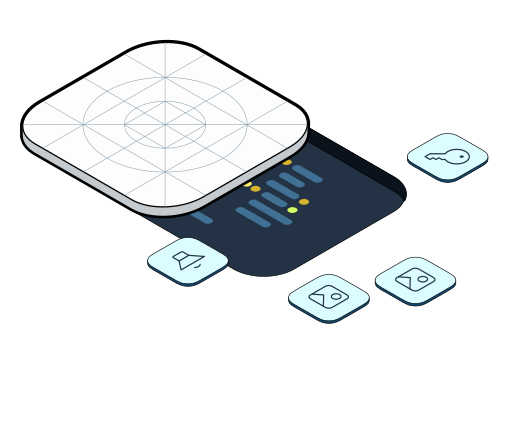
Static protection refers to the controls applied to a mobile application before it runs: code obfuscation, encryption, and the hardening of the application package / container. It prevents attackers from decompiling, analyzing, and understanding the app's code, logic, and embedded secrets.
Without mobile app shielding measures, attackers can design targeted malware around your app's specific logic, clone or modify your app, extract keys and signing logic, and impersonate your app to backend systems, generating requests that look entirely legitimate from the server's perspective.
Static protection is sometimes framed as a way to protect intellectual property, but that framing undersells it. Static protection is the foundation of backend trust. If an attacker can understand your app, they can do far more than copy it.
Static attacks were the first focus area for attackers, but static protection has not become less important as threats have evolved. If anything it has become more important because everything downstream depends on it. That said, it isn't sufficient on its own; once an attacker moves from analyzing the app to attacking it while it runs, a different layer of defense is required.
Runtime Integrity: What RASP (Runtime Application Self-Protection) Really Means
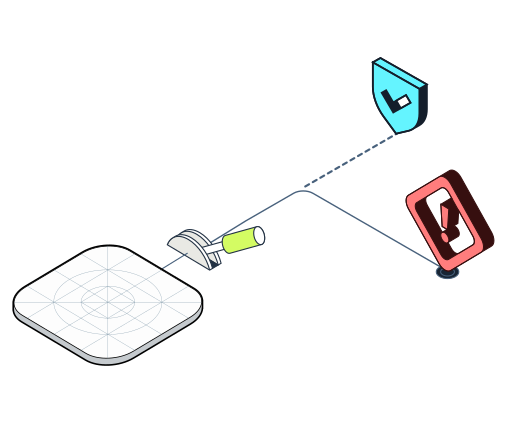
What is Runtime Application Self-Protection (RASP)? It typically refers to security controls that operate while a mobile application is running, rather than before it runs. Where static protection hardens the application package / container, RASP monitors and responds to threats in the execution environment in real time.
Most descriptions of RASP focus on detection of known attack tools, whether that is hooking frameworks like Frida or Xposed, debuggers, rooted or jailbroken devices, or emulators. These are vital, and detecting them really matters. But this framing is narrower than it needs to be.
A more complete way to think about runtime integrity in the modern world is this: RASP should detect and respond to anything unexpected during execution. Not just known tools, but anomalous conditions, environmental manipulation, and any signal that the application is not running as intended or expected. This includes debugging and dynamic instrumentation tools, hooking and code injection, rooted and jailbroken devices, emulators and virtualized environments, malware, overlays, and remote access tools, as well as any runtime condition that falls outside the expected execution environment.
Critically, RASP doesn't just detect but also enforces. When a threat is identified, the application can respond in real time, restricting functionality, alerting backend systems, or preventing execution entirely. This is what makes runtime integrity a meaningful security layer rather than a monitoring tool.
Runtime integrity also matters beyond the app itself, of course. A compromised runtime environment means that signing logic can be traced, keys can be extracted, and API requests can be forged. Protecting execution is therefore not only about protecting the app, but about preserving the trust signals that the backend relies on.
This brings us neatly to the third layer of the mobile channel mentioned earlier: the communication between the app and the backend. Protecting this communication channel depends on everything that comes before it.
Communication Integrity: Why Backend Trust Depends on What Comes Before
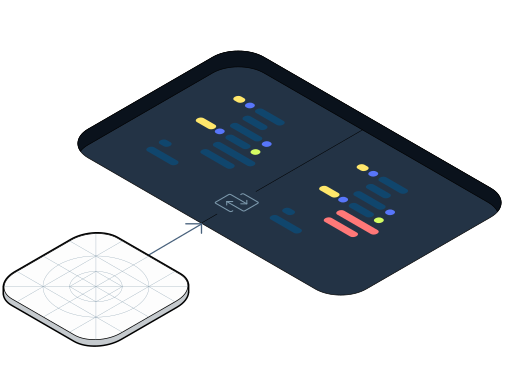
The security of the communication channel between a mobile app and its backend is not independent of everything else. It depends entirely on the static and dynamic protection layers beneath it that we’ve just covered. If the application has been compromised, the runtime manipulated, or the signing logic traced, then the communication channel cannot be trusted, no matter how well it has been protected.
Most organizations protect their mobile APIs using some form of request signing; embedding a secret in the app and using it to authenticate requests to the backend. This is a reasonable starting point. The problem is that if the app can be reverse engineered, then the secret can be extracted. If the runtime can be manipulated, the signing logic can be traced. If the app can be cloned or modified, it can be used to generate fraudulent requests that look entirely legitimate from the server's perspective.
If the application can be modified, the backend cannot trust what it receives.
This is the core problem posed by attackers today and goes a long way to explain why the concept of mobile channel security is so important.
It’s also why mobile channel protection treats communication integrity as the output of everything that precedes it and not a standalone control. App integrity and runtime integrity are prerequisites for backend trust rather than alternatives to it.
We've written a piece about how this plays out in practice - including the full attack chain from MITM, to runtime instrumentation, to API abuse:

Device Trust and Integrity
A big trend over the past decade has been the mobile device becoming the primary trust anchor in digital interactions. UX has been prioritized over everything, and so friction has been reduced, external tokens have been removed, and security has increasingly consolidated onto the device itself. Step-up authentication, trusted device logic, and install ID-based verification have all made the device central to how organizations decide whether to trust a user and their actions.
The problem with this is that device identity can be faked. Device IDs can be spoofed, emulators can present as real devices, and install IDs can be replicated. It’s worth repeating that an attacker who can manipulate any layer of the mobile channel can potentially manipulate the signals the backend uses to establish device trust. This isn’t a theoretical risk but an active and well-documented attack pattern that we’ve seen in the field a lot in recent years.
Even hardware-backed trust signals are not immune. Android devices rely on attestation keys provisioned by vendors at manufacture to prove that a key was generated inside secure hardware. Historically, those keys were reused across large batches of devices – sometimes more than 100,000 – and a steady stream of them have leaked over the years through firmware images, OEM mishandling, and TEE exploits. Tools circulating in modding communities use these leaked keys to forge attestation responses, making rooted or modified devices appear to the backend as clean, hardware-backed handsets.
Revocation is possible in principle, but it invalidates attestation for every legitimate device that shares the key. And at consumer scale, that means breaking the experience for vast numbers of users who have done nothing wrong. The choice is between trusting signals that may already be compromised, or punishing legitimate users for the vendor's mistake. Compromised keys frequently stay valid long after the compromise is known.
A second problem sits one layer down. When an application asks the platform to store sensitive material in hardware, it's trusting the platform to tell the truth about whether that's what happened. On some devices, the call silently falls back to software; the application believes it has written into an EAL4+ secure element when the key material has actually been written to a file.
Ironically, devices have become more vulnerable at the same time that we’ve made them more central to digital trust.
Cross-Validation and Trusted Signals:
How do you validate mobile app integrity at the backend?
Up to now we've described what mobile channel protection requires in principle. The rest of this page sets out how those principles translate into practice, starting with how trusted signals are generated, validated, and used to make security decisions in real time.
This is where the layers stop being separate ideas and start working as a system.
Every layer of the mobile channel generates signals. The application produces integrity signals, the runtime produces environment signals, and the communication layer produces behavioral signals. Together, they form a picture of whether a given session is genuine; but only if those signals can be trusted, correlated, and acted upon in real time.
This is the work that a modern threat and device intelligence solution should do. It should collect tamper-proofed signals from in-app sensors and convert them into verified intelligence that security and fraud teams can use to make risk-based decisions.
Instead of relying on a single signal, a modern threat telemetry system should validate across layers, from app integrity, to runtime state, to device identity, and communication behavior. The goal is to help enable a mentality shift from “refund and react” to “detect and block”.
If a session reaches your backend but no tamper-proofed, cryptographically verifiable signal exists, it is not a legitimate app.
This cross-validation changes the nature of trust decisions at the backend. Instead of a binary pass or fail based on a signature or credential, security teams can evaluate a richer picture and respond with proportionate – and sometimes much more nuanced – actions. They could decide to block a high-risk session outright, delay a high-value transaction pending further verification, or flag a device for step-up authentication. This depth of intelligence means that organizations don’t have to force blunt, blanket decisions.
App integrity, runtime integrity, communication integrity, device trust, and verified intelligence are vital layers that help form a complete picture of the mobile channel. The next section shows how they work together across every state of the data lifecycle.
How does Mobile Channel Protection Work Across All States?
Mobile channel protection is not a checklist of individual controls. It’s a system where every layer depends on the other; where the value of each protection mechanism is amplified by the presence of the others and is diminished by their absence.
Mobile Channel Protection
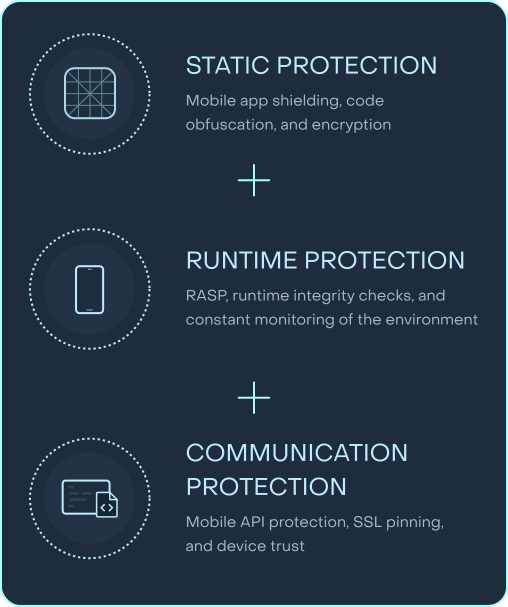
Data at rest: protecting logic before it runs
Code protection, obfuscation, and encryption ensure that the application's logic, secrets, and sensitive assets cannot be extracted or understood through static analysis. This is the foundation of mobile channel protection; without it, every other layer is easier to undermine or bypass.
Data in use: protecting execution as it happens
RASP, runtime integrity checks, the constant monitoring of the environment around an application, and the implementation of a vTEE and white-box cryptography ensure that the app behaves as intended, even in hostile environments. This layer catches what static protection cannot; attacks that happen while the app is running.
Data in transit: protecting interactions with the backend
Mobile API protection, SSL pinning / Certificate Transparency, and interception prevention ensure that the communication channel between the applications and the backend cannot be observed, manipulated, or forged. This layer is only trustworthy when the layers beneath it are intact.
Each layer protects a different moment in the lifecycle of a mobile interaction, but they are not independent. Static protection enables runtime trust, runtime integrity enables communication trust, and communication trust enables backend trust. Remove one of them and the chain weakens; not just at that point, but at every point that follows.
Mobile channel protection means completeness; remove one layer and everything weakens.
The Licel Approach: Integrity, Intelligence, and Isolation
Licel's mobile channel protection suite is built around three interconnected capabilities: Integrity, Intelligence, and Isolation. Each addresses a distinct layer of the mobile channel, and together they form a complete system where the output of each layer strengthens the next.
Integrity: the app defends and verifies itself
DexProtector provides the foundational layer of mobile channel protection and enforces integrity. Via mobile app shielding, RASP, anti-tampering controls, and communication hardening, it transforms a standard mobile application into one capable of defending itself, detecting threats in real time, and ensuring that only genuine, unmodified versions interact with backend systems. It has been independently evaluated by EMVCo under SBMP SPT for six consecutive years.

Intelligence: trusted signals inform smarter decisions
Alice Threat Intelligence converts signals - already tamper-proofed by DexProtector - into real-time intelligence that security and fraud teams can use to make more nuanced and sophisticated security decisions. Via one of three consumption models – the Alice Dashboard, the Enterprise API, or the real-time data stream – SOC teams gain verified visibility into what is happening across their application’s mobile channel. This enables them to move from a position of “refund and react” to one of “detect and block.”

Isolation: critical operations take place in a secure vault
The Licel vTEE provides a virtual Trusted Execution Environment for the most sensitive mobile operations and transactions, such as device binding, key handling, token generation, request signing, and cryptographic logic. The lock is only as strong as the room it sits in, and the Licel vTEE hardens this room, extending the hardware root of trust through the parts of a workflow that hardware alone doesn’t cover. It has also been independently evaluated and approved by EMVCo (under SBMP TEE) for two consecutive years.
No single layer is sufficient on its own. DexProtector without Alice means strong protection with limited visibility. Alice without DexProtector means signals that can be spoofed. It’s the combination of Integrity, Intelligence, and Isolation working together that creates genuine mobile channel protection.
What Mobile Channel Protection Makes Possible
What are the key benefits of mobile channel protection?
Mobile channel protection exists to enable mobile operations and transactions that can be trusted, devices that can be verified, and interactions that can’t be faked. When every layer of the mobile channel is secured, the following business outcomes follow naturally.
Fraud becomes uneconomic to execute at scale
Reverse engineering, runtime manipulation, and API forgery are all detectable and enforceable in real time. The attacker's cost rises while their reward falls. At a certain point, it simply stops being worth their time and effort to carry out an attack.
Authentication can be both stronger and lighter
When the device itself is continuously verified, step-up authentication can be triggered by genuine risk signals rather than applied indiscriminately. Attention can go where it is needed most without running the risk of irritating other users.
The backend gains a reason to trust what it receives
Tamper-proof signals from the application give the API layer something it doesn't currently have: verifiable evidence that a request originated from a genuine, unmodified app on an uncompromised device.
Compliance becomes evidence-based rather than process-based
Continuous monitoring and verified incident telemetry give risk teams what regulators (and central banks) are increasingly asking for: not assurance that controls exist, but proof that they're working. This supports obligations under frameworks such as PSD2.
At its core, mobile channel protection is about closing the gap between what the backend assumes and what is actually happening on the device. When every layer is secured, trust no longer has to be assumed; it can be verified instead.
Frequently asked questions
What is mobile channel protection?
Mobile channel protection is the practice of securing every layer of the interaction between a user, their device, a mobile application, and the backend system it communicates with. It ensures the integrity, confidentiality, and authenticity of mobile interactions across the application itself, its runtime environment, and its communication with backend systems. It is broader than traditional mobile application protection, which focuses on securing application code.
What's the difference between mobile app protection and mobile channel protection?
Mobile app protection secures the code inside the application, including reverse engineering protection, and preventing tampering and repackaging. Mobile channel protection extends this to secure the entire interaction: the application, the runtime environment it executes in, the device it runs on, and the communication channel with backend systems. Mobile app protection is necessary but not sufficient. Mobile channel protection treats application security as one layer in a larger system, not the whole solution.
Why is securing the code of a mobile application no longer enough?
Modern mobile fraud increasingly originates on the device rather than the backend, and attacks have become more sophisticated than reverse engineering alone. Attackers can manipulate the runtime environment, forge requests, spoof device identity, and use malware that looks legitimate from the server's perspective. Even a well-protected application can be part of a compromised mobile channel. Securing the code prevents one category of attack but leaves the runtime, the device, and the communication channel exposed to other attacks.
Is it worth having a straightforward conversation about your mobile channel security and whether Licel is a good fit?
Protecting Mobile APIs From Bot Attacks
Why request signing alone is no longer enough, and what backend trust actually requires.
read the guide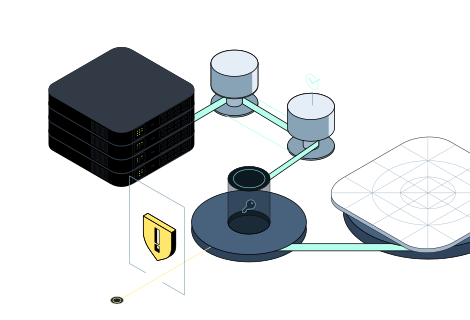
Mobile App Malware Protection
Mobile malware has evolved into a structural risk for banking and wallet apps. Here’s how Licel solutions mitigate it.
read the guide