There’s a particular type of horror film that tends to stick with you long after the credits roll.
It’s the kind that never – or at least rarely – shows you the monster. There’s no chainsaw, no blood, no mask at the window, and no screaming. Instead, you’re introduced to a normal couple in an ordinary living room on an a typical evening, working through their boring, everyday, relatable problems.
But something beneath the scene refuses to settle. An object on the mantel has moved and neither of them can figure out where it’s gone. There’s a lingering sense, impossible to place, that a conversation they held in private wasn’t entirely private. And in the corner of the room, so faint that you might even have imagined it, a thin vertical line of murky white light appears that wasn’t there a second ago.
Nothing particularly significant or scary happens at first, and that’s kind of the point. The dread isn’t in any single nightmarish event but rather in the heaviness of the room itself and the conversations between the people in it.
The anxiety you feel watching it is close to how it feels to carry your life around on a mobile device. Most of you reading this will know that low, ambient, but swelling buzz that accompanies the suspicion that you’re being watched, that you’ve shared something you probably shouldn’t have, and that the phone in your pocket knows more about you than it admits.
It’s a feeling that tends to get waved away as paranoia. But after fifteen years spent watching the mobile threat landscape, we’d suggest that it isn’t paranoia. It’s simply an accurate reading of the room.
A room that was never built for this
Since Licel was born at the end of June 2011, the phone has quietly become the place where everything converges. Identity, finance, healthcare; the dozens of small acts of digital trust that hold an ordinary day together between waking up and going to sleep.
Tasks that used to be spread across your wallet, desk drawer, and bank branch all now happen on a single device. Convenience won; completely, and probably for good. What that win quietly created is the harder thing to talk about.
The room where everything of value is kept is also the room most worth watching if you have malicious intentions. The mobile channel – the whole interaction between a person, their device, the apps they rely on everyday, and the systems that those apps talk to – has organically become the most contested space most people own, without anyone really deciding that it should. But it’s worth reminding ourselves sometimes that the phone wasn’t designed to carry all of the sensitive tasks that we now rely on it for; at least not securely. The unease we feel is just a quiet recognition of exactly that.
Mobile attacks today are subtle and sophisticated, and mostly invisible from the end user’s point of view, which raises the question: does the phone feel like the safest place to keep a life precisely because we rarely see what’s trying to get in?
Fifteen years of watching the weather change
If the room is the thing that stays still, the weather is everything that’s moved around it.
We started out at a time when apps were just beginning to gain traction, when people were slowly getting used to the idea of the device in their hands being more than a communication and entertainment tool. Mobile threats were cruder and easier to picture back then. A bad actor would typically carry out a static attack: pulling an app apart, reading its secrets, and building a convincing copy of it. They would profit from something a developer had poured their heart into, the damage arriving one app at a time.
The first thing that changed was the tooling. Attackers stopped needing to dismantle an app statically at all and started simply leaning on it, observing it while it ran. What we call dynamic attacks often involve hooking into the application, and rewriting its behavior in real time on the device in front of them. It’s almost as if the threat moved from the workshop to the live stage.
The economics changed too. What had once required real skill increasingly became a matter of supply: kits, services, and shortcuts meant that fraud stopped being only something you did and became something you could buy.
Then the world changed profoundly. The COVID-19 pandemic was the final push for moving nearly all of our daily activities onto screens, and primarily onto the one in our pocket. It also handed attackers a population that was more anxious, isolated, and primed to act on urgent messages from supposed authorities, whether about health, money, or work. The lever was never the technology. It was the fear; the heaviness that was already in the room.
Most recently, the line between the technical and the human has all but collapsed. AI gives attackers a face that passes a video call, a voice that sounds exactly like a daughter or a director, and a synthetic identity convincing enough to be enrolled as a real one. In the identity-verification bypasses we now see in the field, a fabricated video can be injected directly into the camera feed an app trusts, so the face that clears a liveness check was never in front of the phone at all. Phishing used to look cheap and obvious. It doesn’t have to anymore: deception can now be both cheap and entirely convincing.
Threaded through all of these shifts is the same figure we’ve watched for the last fifteen years. Behind each one is a person: an end user opening what looks like an official message, approving a request that arrived at precisely the right moment, trusting a face on a screen their own eyes have no reason to doubt. The weather kept changing, year after year. The person caught in it never did.
You can’t secure a feeling
Every successful attack we’ve witnessed, across every era, has come down to the same combination: a technical opening and a human being persuaded to walk through the door it opens. The device has always been the route rather than the destination.
And the things attackers have reached for in people are nothing new; trust, urgency, deference to authority, a simple instinct to be helpful. These aren’t flaws to be trained away; instead they are how human beings have been built to operate for as long as there have been human beings.
One of the oldest ideas in security – that the deceived were careless, that they should have known better – is due for a rethink. People who are fooled are usually not being careless, but are behaving exactly as people behave, inside situations on mobile devices that are engineered to look completely legitimate.
The usual response is to ask people to be more careful, to spot the signs and slow down. But you can’t patch a reflex, and it isn’t reasonable to ask someone to carry around a low background dread as the price of a normal modern life.
So the sustainable answer is a different one. If trust can no longer be guaranteed by a person's judgment in the moment on the device – and it can’t – then it has to be protected somewhere more reliable: in the mobile channel itself. If the integrity of the application can be assured, then it cannot be cloned or quietly rewritten. If its most sensitive operations can be carried out in an isolated environment, the keys to a digital life cannot be lifted out of it. The idea is to build a channel that stays trustworthy even when the person using it has been fooled – and to provide the visibility to know, in real time, when something in the room feels wrong.
Why we protect the mobile channel
Over the past fifteen years, our own language has slowly changed: from protecting an application to protecting the whole mobile channel. This was a strategic decision born out of an admission. Watching the attack surface widen year after year eventually forces you to say out loud what you’ve been seeing; that the app was only ever one wall of a room that kept getting larger.
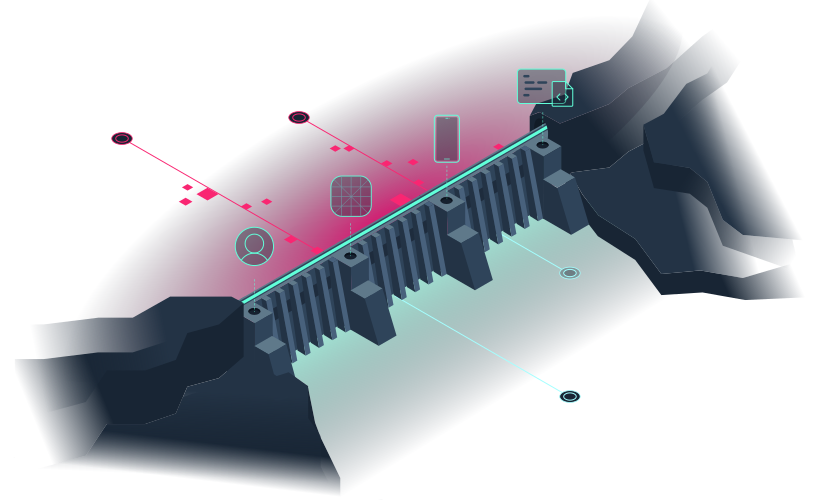
The wall still matters. If anything it matters even more, because everything else now leans on it. But a wall is not a room. A mobile interaction isn't code sitting still in an app store; it's that code running on a device you don't own, in an environment you can't see, talking to a backend that has to decide – often in milliseconds –whether to believe what it's hearing. Protecting the code isn’t the same as protecting the interaction. And if any part of that interaction can be quietly altered – the runtime instrumented, the device's identity faked, the request forged on its way out – then the backend is trusting a story it has no way of checking. What the channel needs is completeness, not coverage: every protective layer needs to be intact because each one is what makes the next worth trusting.
None of this, in the end, is really about walls or rooms, of course. It's about the person inside. The whole point of protecting the mobile channel is to take the weight off the one part of the system that was never built to carry it: the human being holding the phone, who will, sooner or later, be shown something highly convincing that was engineered to fool them, and who shouldn't have to be the last line of defense when they are.
Fifteen years is a long time to watch a single room this closely; long enough to learn that the monster at the door was never the real story. The real story was the flash of vertical light; the quiet figure in the corner of the room, and the sense that something had already gotten in, but without any reliable way of knowing if it had. What we’ve learned about keeping that room trustworthy – and how the layers of protection actually fit together – is set out in full on our Mobile Channel Protection page.
The technical and the human have never been as entangled as they are now, and AI will only pull them closer. The unease isn’t going anywhere. The most any of us can do – and the work we chose fifteen years ago, and have chosen every year since – is to make sure the person living in that room doesn’t have to face it alone.